
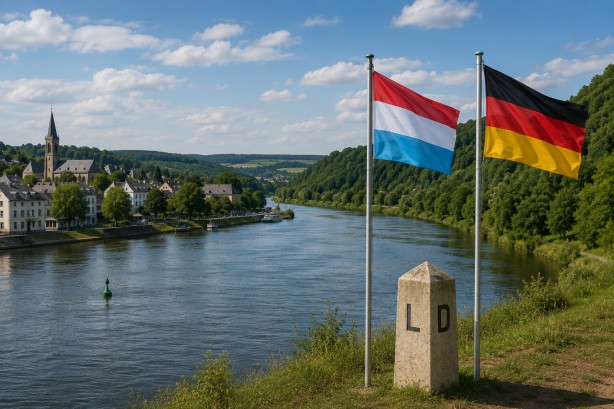
Luxembourg and Germany share a unique border arrangement that sets them apart from most European countries. Instead of a conventional dividing line, the Moselle, Sauer, and Our rivers are jointly governed under the German-Luxembourgish condominium. This system, which places the rivers and their islands under joint sovereignty, originated from the Congress of Vienna in 1815. Following the Napoleonic Wars, European powers redrew borders, and Article 25 of the Congress’s Final Act established the rivers as shared territories, an arrangement later confirmed by treaties signed in Aachen in 1816 between the Netherlands and Prussia.
As Luxembourg gained independence and Prussia became part of the German Empire, the rights established in the 19th-century agreements persisted. The modern border between Germany and Luxembourg largely reflects these historical arrangements. However, the status of bridges crossing the shared rivers remained ambiguous for over a century. This uncertainty was addressed after the canalisation of the Moselle, leading to negotiations in 1979. A border treaty signed in 1984 clarified that bridges and footbridges would also be part of the shared territory.
Currently, the condominium operates under a system of concurrent jurisdiction, allowing both German and Luxembourgish laws to apply. Bilateral agreements facilitate the resolution of potential conflicts within this shared space. Police from both countries can conduct operations in the area, including joint patrols. In instances of offences occurring on a shared river or bridge, officers from either country may intervene. Jurisdiction over subsequent legal proceedings often depends on factors such as the individuals involved and the specifics of the offence.
This arrangement exemplifies a rare instance of shared sovereignty in Europe, resulting in a distinctive border that functions differently from the conventional boundaries that separate most nations. The German-Luxembourgish condominium remains an intriguing example of international cooperation and shared governance, stemming from agreements made more than two centuries ago.