
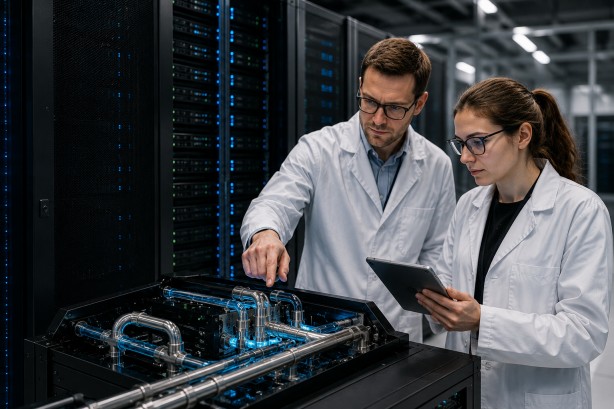
Amid the increasing demand for artificial intelligence, researchers in Switzerland are pioneering new cooling technologies aimed at enhancing the energy and water efficiency of AI data centers. Scientists from the Swiss Federal Institute of Technology in Lausanne (EPFL) are collaborating with start-up Corintis to develop advanced liquid-cooling systems. These systems are tailored to align with the thermal properties of individual computer chips, promising a reduction in cooling energy consumption by approximately 20% while utilizing less water compared to traditional methods.
A significant aspect of this development is the focus on repurposing waste heat generated by AI servers. Instead of allowing this heat to dissipate into the atmosphere, the researchers are devising strategies to redirect it into district heating systems during the winter months, or alternatively, convert a portion of it back into electricity during warmer seasons. This innovative approach not only enhances efficiency but also contributes to sustainable energy practices.
As AI processors emit significantly more heat than conventional computing systems, experts emphasize the growing necessity of liquid cooling. However, they also caution that while these advancements in cooling technology are crucial, they alone are insufficient to mitigate the overall environmental impact of AI. The relentless surge in demand for AI services continues to escalate global electricity and water usage.
The collaborative efforts in Switzerland highlight a proactive approach to addressing the environmental challenges posed by the expanding AI industry. By improving cooling technologies and implementing waste heat recovery systems, researchers aim to contribute to a more sustainable future, balancing technological advancement with environmental responsibility.